Artistic Director: Elizabeth LeCompote
Introduction
We have been looking at the Wooster Group and the devices they use to devise a piece of theatre using things such as theme, discourse, media etc. The different materials that they use rarely go together, but usually have some relation to the on stage action.
House/Lights
We viewed their performance ‘House/Lights’ which starred Kate Valk as the traditional narrator in the piece. I wasn’t entirely sure what to make of the piece and felt a bit lost at times but her character especially interested me. She was the picture of the perfect black and white movie star and at times she appeared as if she was part of the media. Ben Brantley from the New York Times wrote.
“And in the evening's master of ceremonies, the magnificent Kate Valk, we have a creature of astonishing artificiality, a tin-voiced 1930's-style beauty with marcelled hair and bee-stung lips who might be a digitally manufactured composite of movie stars. She's the ultimate screen siren, happiest in two dimensions.”
Ben Brantley (1999)
Even though her character was part of the madness she made me feel as an audience member like she could be trusted. She created an anchorage point for the audience to come back too.
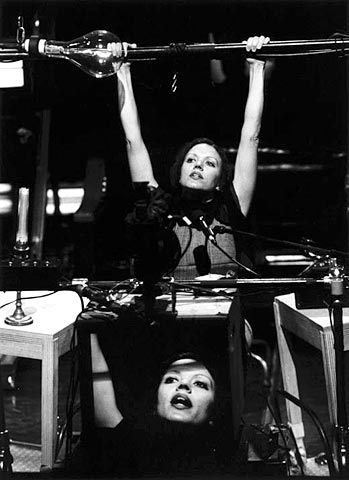 |
| Kate Valk in House/Lights (1999) |
The Cherry Orchard & Classwork
“You don’t have to worry about meaning it’s all here it’s like this space is an extension of our lives”.
Page 51 Breaking the Rules: The Wooster Group David Swan (1986)
What this quote is explaining is that we as actors and devisers may look at a space and say what can we add to realistically portray what we mean? We had a tendency to do this when working on the Cherry Orchard.
 |
| The Cherry Orchard |
We have been working with The Cherry Orchard to create a piece in the style of the Wooster Group. What we have been doing so far has all been about creating a piece that looks good instead of just going with something. We were going to add a horror discourse to our piece, but we realised we were being too literal. We were just finding clips that were scary but we weren’t looking at the relationship to the cherry orchard. In this case we were taking the some of the devices of the Wooster group, but not really working in the style of Wooster group.
We started again with our plans for the project and really tried to go back to the tasks and get too the root of the Wooster group. We really had to focus on not getting a good mark but on getting to the bottom of their techniques. Once we did this I think we produced performance that with more polishing could have been really good.
I found working with the techniques of the Wooster group really hard as I found it difficult to understand what they were doing and why they were doing it. So I decided to do some research into their other projects to understand them further.
Route 1&9
Because I struggled to grasp what the Wooster Group was and what they were trying to do I decided to look into one piece that not only intrigued me but offended me at the first glance. With its bold images of caricatures of afro Caribbean people acting in stereotypical ways at first, I thought this was hugely racist something in league with ‘Gollywog’ toys. But after further research into the production it was apparent that it was rather a display of the stereotypes.
 |
| The images deemed as racist from 'Route 1 and 9' (1981) |
In The Wooster Group and Its Traditions it says:
“At the time the group knew that the black face Pigmeat Markham sequence was objectively racist, but they believed it simultaneously assumed a confrontational stance towards the audience’s racism as well as their own, that it was an attack on self-congratulatory liberalism (Vawter, qtd. In Savran, 1988: 14)”.
Johan Callens (2004)
This explains that the Wooster Group was challenging the views of the audiences and themselves on what they think is racist and what isn’t. They were looking at how Afro- Caribbean people were viewed in that time, social and political culture and making people face what was happening, basically saying what no one else would say.
I think one of the reasons the show was jumped on and why their funding was dropped was that the culture wasn’t ready to face up to themselves and their own views. It made them uncomfortable to have to think about and so they condemned the company for simply stating and displaying the performance.
Conclusion
So In conclusion The Wooster Group is a company that is challenging the views of Performance and Theatre, with their techniques for devising. They may not be a company I would follow for devising purposes but I can respect them for the inventive work they do and the pieces they create.
Bibliography
SAVRAN, D. (1986) Breaking the Rules: The Wooster Group. (P 51) United States, Theatre Communications Group Inc.
BRANTLEY, B. (1991) THEATER REVIEW; A Case For Cubism And Deals With Devils. New York Times, 3/2/1991, pg1. Available from: http://theater.nytimes.com/mem/theater/treview.html?res=980DE0DB1338F930A35751C0A96F958260 [28/12/2011].
CALLENS, J. (2004) The Wooster Group and Its Traditions. (P 165) Brussels, Peter Lang

